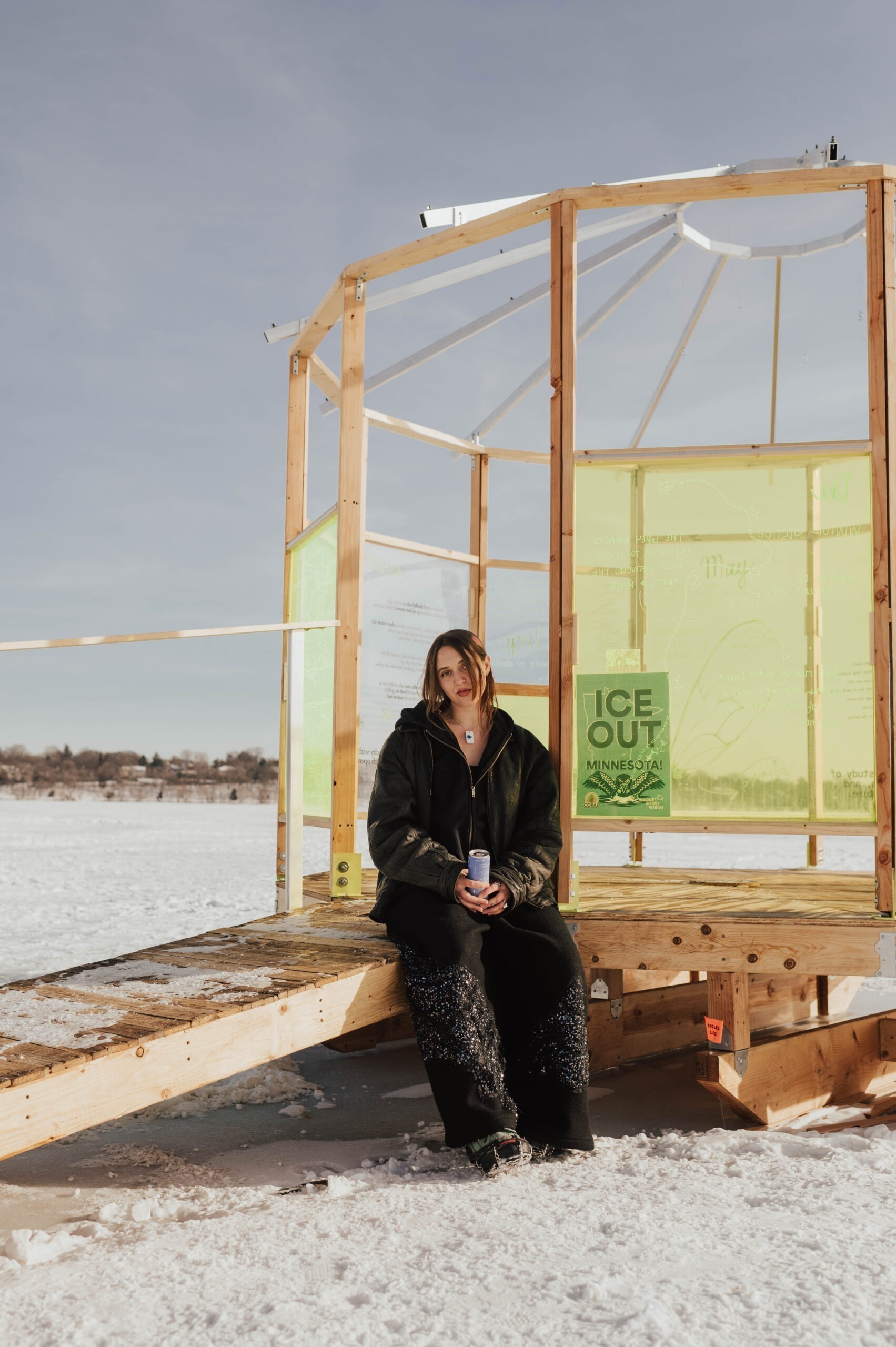
A Practice of Witnessing: Inside Rhianna Hajduch’s Art ShantyFebruary 16, 2026
Out on the ice of Bde Unma (Lake Harriet), we stepped into Rhianna’s latest Art Shanty, an immersive pavilion built to be experienced rather than viewed. Between the wind and the winter quiet, her installation invites visitors to slow down and consider the cycles shaping both the natural world and their own lives.
Q: How did you first become a multi-disciplinary artist, and what mediums pulled you in originally?
A: I think all creation is an evolution, and likely many who become artists first saw themselves in the art of others first. When I was much younger, over 10 years ago, I was a reader and a writer. Over time, that type of observation evolved into photography to document life and the natural world. Eventually, I ran a collaborative project with my first major project collaborator, Damaris Benitez Franco, who also worked on this project alongside me. Our project revolved around people + the planet, fashion, design, and curating events and experiences. At the same time, I was interested in sound design and bioacoustics (the study of the natural world through sound) and I wanted to combine those projects. Long-story-medium, I was pulled into the world of creative direction for musicians in the music industry around 2021 and subsequently began collaborating with many artists throughout the Twin Cities, through this process I developed my creative eye, visual language, technical skills, and theoretical framework for how I approach artmaking and collaboration. In this process, I synthesized all of this unfolding to begin curating a body of work called Symbioscia, a project with a thesis surrounding the feeling of intuition and understanding that guides all life. Artmaking has been a means of survival, a conversation with life, and a lucky way to connect with many incredible and brave people and unbelievable places on Earth.
Q: Were you always interested in nature-based systems, or did that come later in your practice?
A: My work has always centered on this idea of life on Earth– whether that be through poetic observation, memoir, documentary, or ecology and biology. For me as a somewhat lonely young person, I found a sense of ‘home’ in movement, incomprehensible places, walks alone through the neighborhood and reading a book in the trees, moving buses in the night through the jungle, and the kindness of strangers and the unexpected. So, I think my devotion has always been to that: nature and the beauty of life on Earth.
Q: How has living and working in Minnesota shaped the way you think about time, seasons, and change?
A: There are infinite ways to discuss how I have been carved out and molded by this place, but I have two immediate examples:
- There is a small, hidden beach down a long, wooded path that I have returned to over many years and eras in my life with various people I care deeply for, and many times in my own company. My first article about ‘Phenology’ for Something to Say magazine paralleled what I witnessed by returning to this same piece of landscape again and again with what I witnessed within myself and the cycles I move through internally. It taught me more than I can summarize, but it reminded me how our human ancestors understood time and place, our biological programming to be attuned to the world around us. It taught me that we can see our own internal unfoldings as a reflection of the natural world. And, it taught me about the importance of witnessing.
- I spent time over the last few years in conversations with a professor in bioacoustics who emphasized the importance of shifting baseline, or the idea that what was once normal when it comes to the natural world and its seasons no longer is. Only those who were alive to witness what once was will be able to recall it. There is a huge importance to witnessing, storytelling, and furthermore, traditional and Indigenous knowledge which has been attuned to the natural environment for countless generations. I personally think of spring and storm season in Minnesota as an example of this. As a kid, I remember the slow gradient from winter into spring, playing in the basement due to a tornado warning, cumulonimbus clouds downpouring over one backyard and sun piercing through the rain from another. Nowadays, our springs tend to be more jumpy, going from blizzards to hot weather or months of gray cold, rain on end.
We wanted to use the Phenology Wheel pavilion to ask people about what they have witnessed, whether it be in their own backyard or afar.
Q: What makes the Art Shanty Projects unique compared to a traditional gallery?
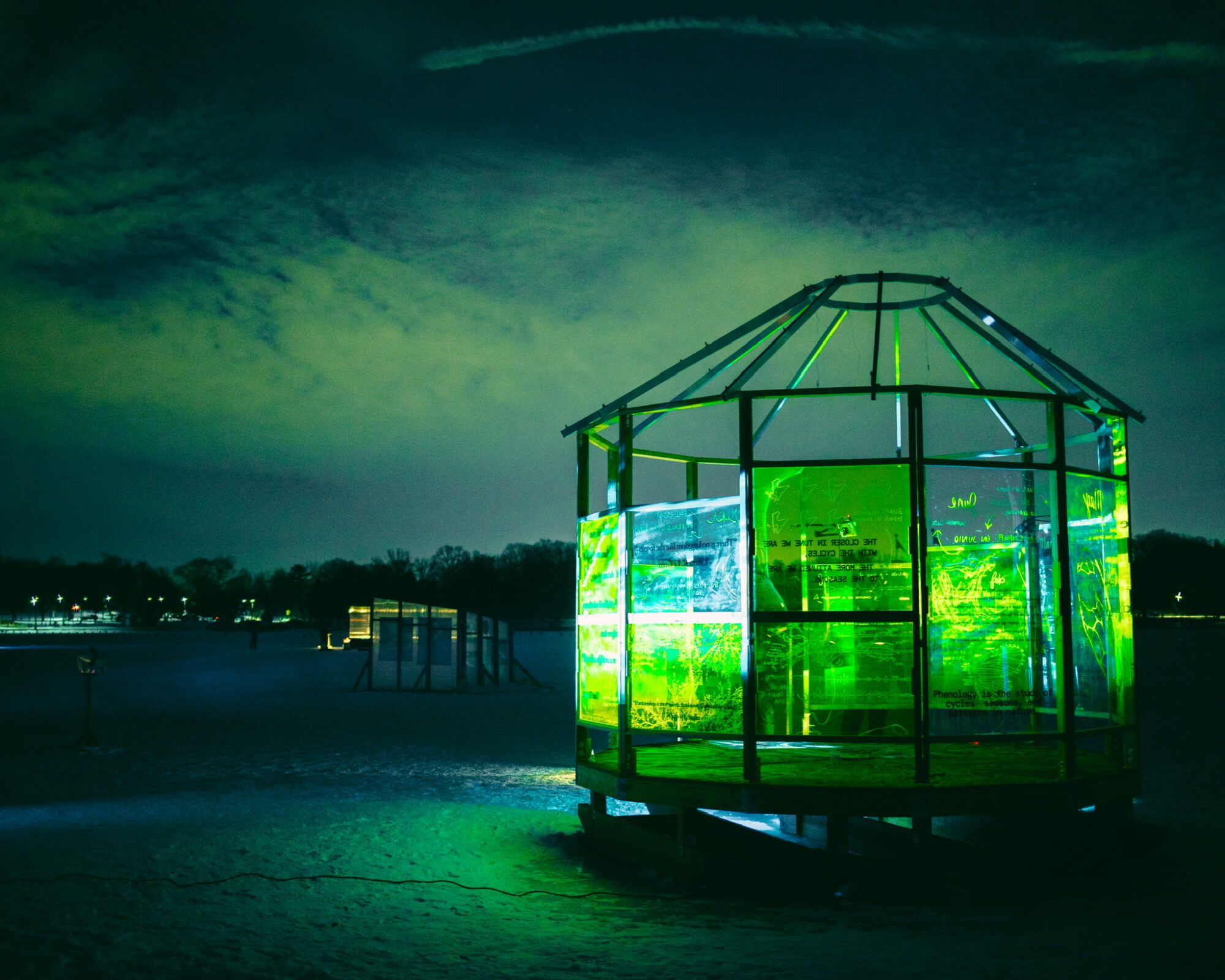
A: The Art Shanty Projects take place on a frozen lake (Bde Unma/Lake Harriet) over the winter months. It is a free, donation-based event and it is open to all ages. The Art Shanties are unique in their approach to curating in an untraditional environment in conversation with the elements. In addition to this, they are colorful, playful, and engaging for people of all ages, where most gallery spaces are more peer-based and limited to certain audiences.
Q: How does creating work on a frozen lake change your process? What were the biggest challenges designing a work for ice and weather?
A: The timeline, budget, and logistics of curating a physical space and experience for people of all ages in very tough conditions inform the process greatly. We had to stay within a certain weight limit to place our structure on the frozen ice. We also had to build skis onto our structure so we could get it on and off the ice. Additionally, the wind was a key consideration and made the decision for us to leave our structure open-air facing the sky. Luckily, my team (Abel Santos Meeker, Vernon Vanderwood, Connor Garber, Damaris Benitez Franco) was made up of highly creative people who are well skilled fabricators and were able to be fluid with the ever-changing process.
Q: What kind of interactions do you see happening between visitors and artists out there?
A: We got to spend each of our weekends for four weekends this winter having conversations with people about the places they’ve been to that have shaped their lives the most, and the natural cycles and phenomena they have experienced over time that have marked their nostalgia and the tone of some of their most formative experiences. Personally, I got to hear testimonies from people older than me who told me of the butterflies in the midwest before the explosive use of pesticides like glyphosate and other ways they’ve seen the world change over time. We also have connected with people who do really incredible conservation work across the midwest who may have a use for our installation across different seasons.
Q: Can you describe your shanty and what visitors experience when they step inside? What do you hope people take with them after visiting?
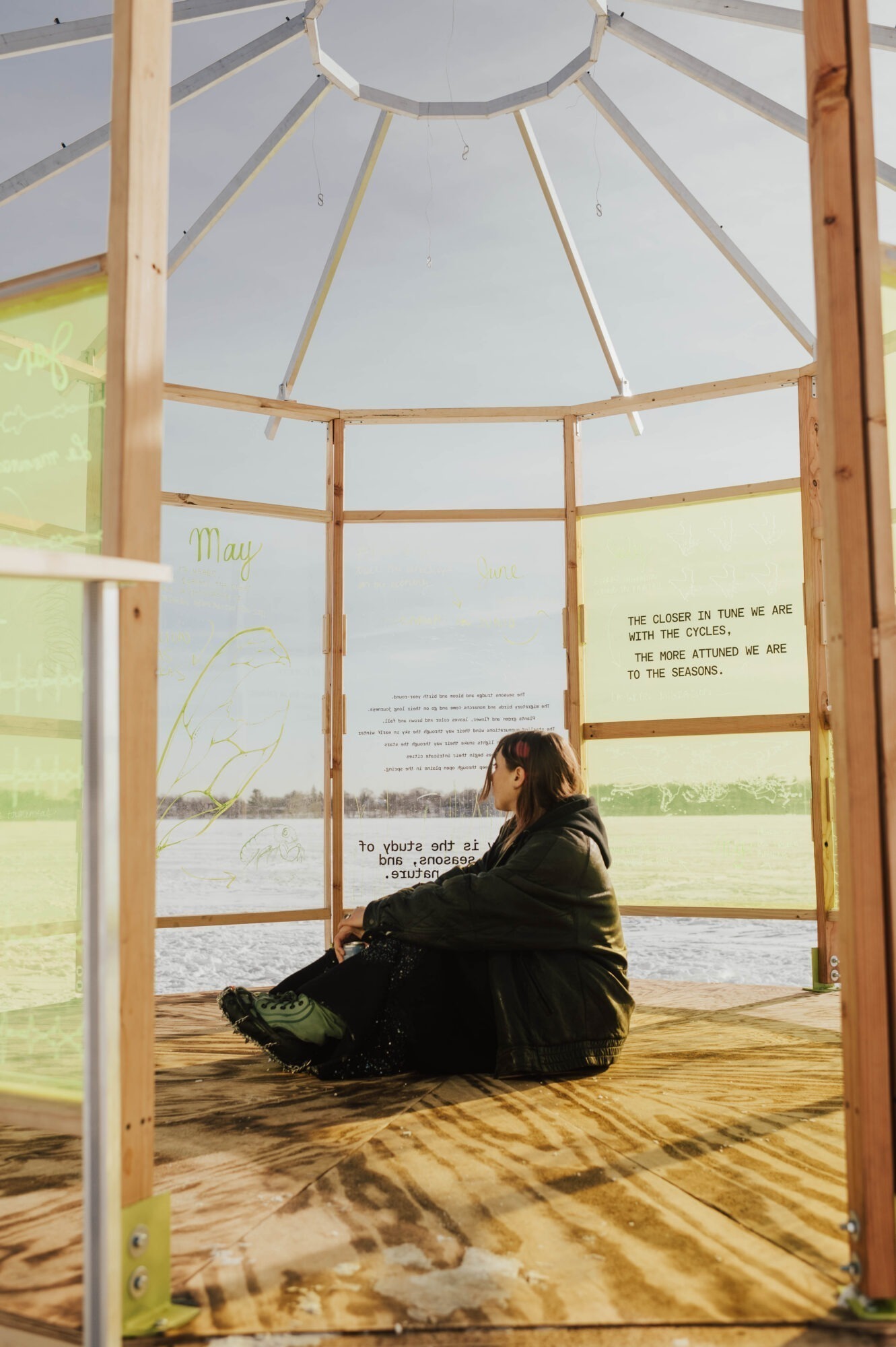
A: Our shanty is meant to be an immersive version of a Phenology Wheel. Phenology Wheels are interactive scientific tools anyone can create to map out the cyclical shifts of a species or phenomena in nature. The basic template of a Phenology Wheel looks like a pie chart, where in each slice, you can draw what kind of change a plant, animal, or landscape is undergoing over time.
Our installation is a Phenology Wheel that looks at life on Earth from an aerial view. As a participant, you can step into and witness an overview of some of the grandest phenomena, movements, and cycles that occur on Earth as a whole- from the starling murmurations to the grey whale migrations. We divided our installation into 12 quadrants to represent each month of the year with a respective cycle or movement. In the center of our structure, hanging beneath the sky, we had a soft, woven sculpture meant to represent a starling murmuration that people could contribute a bird or butterfly to (brought to life by Vernon Vanderwood).
We hoped our space could be used as a vector for conversation and recollection of our shared testimonies of life on Earth, a reflective space, and a space of reverence for the intelligence of natural systems.
Q: For people unfamiliar, what is the phenology system and why does it matter?
A: Phenology is the study of cycles and seasons in nature. Studying Phenology teaches us that the more attuned we are to the cycles, the more attuned we are to the changes. In this attunement, we can celebrate the growth, intelligence, and evolution of living systems, as well as be advocates for preserving what may be at risk.
Q: What drew you to phenology as a framework for art? How does observing seasonal patterns change the way we move through daily life? What have you personally started noticing since working with these systems?
A: As I mentioned previously, going through a hugely transformational time in my life that was filled with grief, transition, and regrowth, paired with my continual returns to a specific spot in nature, showed me the similarities between my own intuition and cycles and those of the world around me. I was taught by lived experience and the natural world the importance of loving people and life on Earth in their dynamic nature.
When we can be witnesses to ourselves, other people, and the natural world in their deepest intelligence and in their chosen adaptations, we can better understand how we fit together in the wide web of things and respect the larger exchanges of all life.
In my process of studying Phenology, I have become more soft and compassionate with myself: understanding that the processes of life are always underway and often subtle, nuanced. I feel more trusting to listen to that which pulls my heart in the direction of what I love. I feel a deepened respect for other people who are learning and adapting through their own complex and necessary processes. I feel exalted to be a witness to the great patterns of the natural world: the destruction and regrowth, the long migration pathways that affirm life and longevity, the synchronization of thousands of birds in flight in unison.
Q: Where can people see your work next? Are you continuing to explore phenology in future projects?
A: I am currently curating and finalizing my first Symbioscia project, Hypervolume. I am in development of a body of work titled Phenology, including a longer film/documentary component. Creation takes time, and I am trusting the unfolding to guide the work where it belongs.
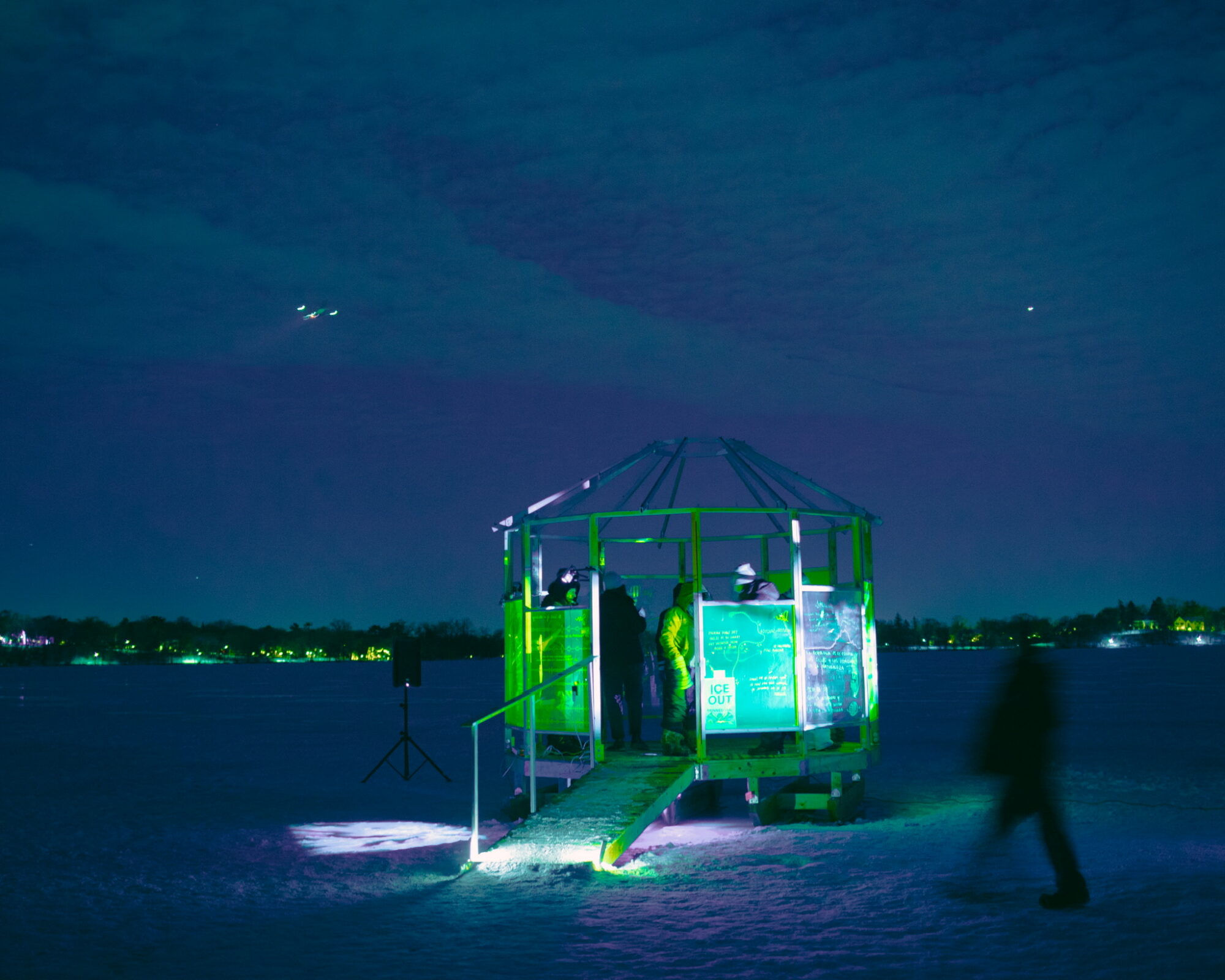
We hope to install the Phenology Wheel pavilion across different seasons and landscapes and change its precedent (presentation) to reflect seasonal shifts.
Q: How can people follow or support your work going forward?
A: My team consisted of:
Abel Santos Meeker- my project co-director and the lead architect of the Phenology Wheel pavilion
Vernon Vanderwood- frequent collaborator, amazing bioartist and fine artist, and fabrication + sculptural design for this project
Connor Garber- frequent collaborator on Symbioscia projects, designer, highly skilled fabricator
Damaris Benitez Franco- long term co-creator, fashion and textile designer who runs D.B. Franco design
And myself- I was the concept lead and a producer for our installation
- our countless incredible, consistent volunteers.
In the nighttime images and videos, Orion of Ecophonic curated sound and dance, and Hollie Leggett curated audio-visual projections.
My work can be found under my personal page, my project: Symbioscia, and upcoming collective in collaboration with Vernon: Ecotone.